


Does nativism travel? Notes from a research stay in Australia
Published:
The far right is no longer a European story. Parties, movements and candidates that were once treated as a regional anomaly now win elections, shape legislative agendas and set the terms of public debate across Latin America, North America, Asia and Oceania. Our concepts, however, were built somewhere specific. Most of what we use to identify and compare these actors was developed to make sense of Western European party systems. My current project asks a simple question with awkward implications: what happens to those concepts when they travel?
The Latin American puzzle
Nativism is a good place to start, because it is precisely the concept that scholars of Latin America tend to set aside. The standard objection is empirical and, on its face, persuasive: if nativism is about defending the native-born against immigrants, and immigration is not a salient issue in most of the region, then nativism cannot be doing much analytical work. Chile is often mentioned as the partial exception. Everywhere else, the argument goes, we should look elsewhere.
I think the objection tells us less about Latin America than about how narrowly the concept has been read.
Going back to the roots of the concept
My argument is theoretical before it is empirical. I return to Mudde’s (2007) definition of the populist radical right, and to rival conceptualisations developed in the European literature, to show that the definition of nativism was never restricted to immigration. Nativism is built on a relation between a “we” that is entitled to the nation and an “other” whose presence is framed as a threat to it. Immigrants are one candidate for that position. Ethnic minorities are another, and they become far more visible as the constitutive other when there is an electoral or constitutional contest over expanding their rights.
The second move concerns the “we”. In post-colonial democracies, the idea of a homogeneous nation is not a background assumption that can be taken for granted, it is an ongoing political construction that has to be actively defended, precisely because Indigenous peoples have a prior claim to the territory. That makes the “we” more complex than the European literature usually allows, and it makes the moments when recognition is on the ballot particularly revealing.
Two post-colonial democracies
I study Australia and Chile. Both held a national debate on the political rights and constitutional recognition of Indigenous peoples, and in both cases far-right politicians, or politicians backed by far-right parties, argued publicly against them. What the two cases share is not a party system or an institutional design, it is a condition: they are post-colonial democracies in two very different regions, in which the boundaries of the nation were being openly renegotiated. Whether the arguments mobilised against recognition actually converge is not something I assume going in, it is one of the questions the analysis is meant to answer.
The material is speech transcripts, from the plenary debates of Chile’s Constitutional Convention and from the Senate of the Australian Parliament. I analyse how the homogeneous nation is constructed in those speeches, combining unsupervised topic modelling (LDA) with supervised classification using large language models, so that the inductive structure of the corpus and the theoretically driven categories can be read against each other.
What the stay added
During my research stay I complemented this analysis with archival work on campaign material in Sydney and Canberra, which brought in the visual and rhetorical register that parliamentary transcripts leave out. I also presented the draft paper at a seminar of the Centre for Deliberative Democracy and Global Governance at the University of Canberra, where I was appointed Visiting Researcher.
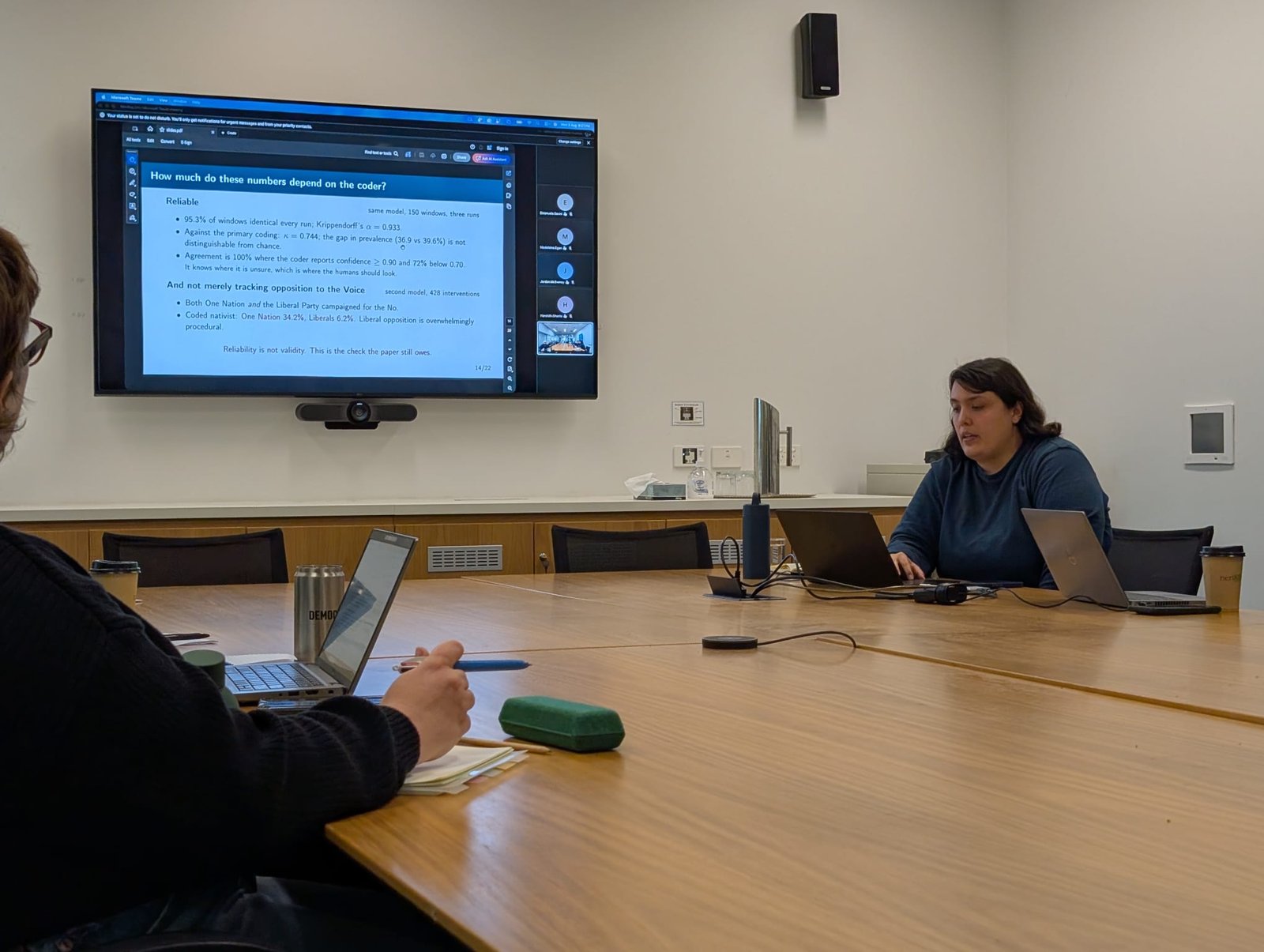
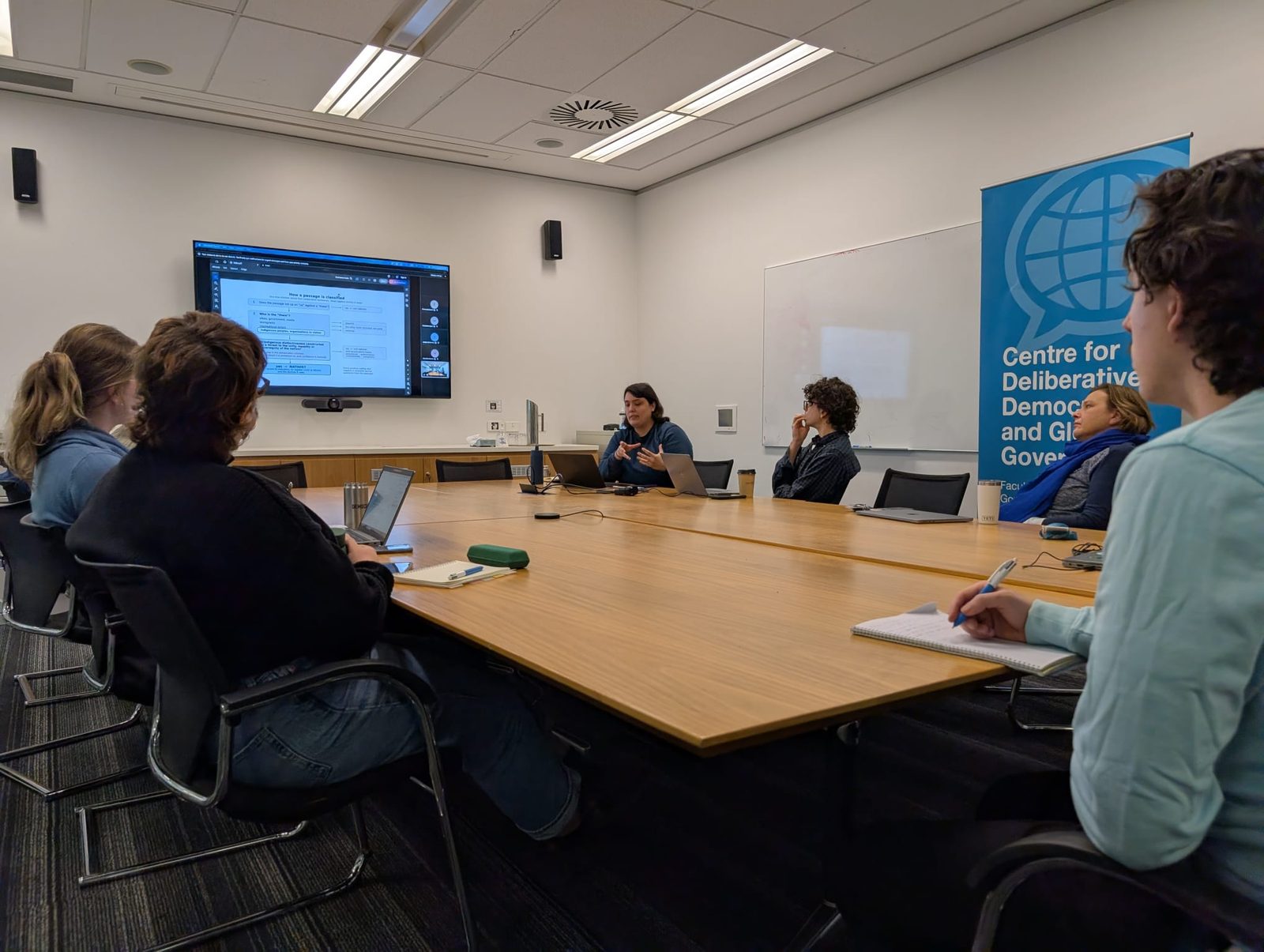
The feedback was generous and genuinely useful, and I am now working it into the manuscript. The paper has also been accepted for the Australian Political Science Association conference in November, near Melbourne, which will be the next occasion to test the argument with an audience that knows the Australian case far better than I do.
If you work on the far right, on Indigenous politics, or on text-as-data approaches to political speech, I would be glad to hear from you.